J. Brown
j@jbrownyoga.com
917-446-8871
Experienced Registered Yoga Teacher (ERYT500)
Continuing Education Professional (YACEP)
Registered Yoga School (RYS200/RYS300)
1995-2007 Independent Yoga Teacher in NYC
2007-2017 Owner of Abhyasa Yoga Center in Brooklyn, NY
2017-2020 International Yoga Teacher Trainer and Podcaster
2020-2024 J Brown Yoga Online Platform
2024-Present Owner of The Birdhouse Yoga Center in Easton, PA
Bio (short):
J. Brown is a yoga teacher, writer, and podcaster. He is at the forefront of a quiet yoga
revolution, based in healing, that seeks to change the dialogue and direction of yoga practice
in the west. His writing has been featured in Yoga Therapy Today, the International Journal of
Yoga Therapy, and across the yoga blogosphere. His podcast is internationally renowned for
raising the level of conversation. Visit his website at jbrownyoga.com
Bio (long):
For more than twenty years, J. Brown has been developing techniques to teach people how to
practice yoga in a deeper and more fulfilling way. He is also a well known writer and podcaster,
having been featured in Yoga Therapy Today, the International Journal of Yoga Therapy, and
across the yoga blogosphere. His podcast has become the premier resource for yoga teachers
and center owners.
J. Brown came to yoga by way of his mother’s death. Reconciling that loss, and wanting to be
free from the crippling grief and disillusionment that came with it, fueled his passion for
learning to make himself well.
First, he gravitated towards an Ashtanga, power vinyasa style. The intensity suited his
struggling temperament. After sustaining several injuries, he explored an Iyengar
based approach to learn better alignment. But he soon discovered that better alignment alone
was not the answer. Despite having achieved proficiency in both the Ashtanga and Iyengar
styles, studying with renowned teachers such as Alison West and Richard Freeman, J admits: ‘I
still had chronic pain and was horribly disillusioned and unhappy.’ The next phase of his search
would be in India.
In Rishikesh, J. found a rare and special teacher in Swami P. Saraswati. He taught J that yoga
practice was not a linear progression towards some unknown thing, but rather a process of
learning how to take care of yourself. Back in NY, J. stopped going to regular group classes
and devoted himself to a self-practice, ultimately meeting one his most influential teachers
Mark Whitwell and finding his way to an entirely therapeutic orientation inspired by the TKV
Desikachar/Krishnamacharya tradition.
In 2007, after more than a decade as a popular teacher at various schools in Manhattan and
Brooklyn, J. founded Abhyasa Yoga Center in Brooklyn, NY to provide a home for yoga
practice that adapts to individual needs. In 2017, J closed the center to travel, write, and talk
about the important issues and focus on his work changing the dialogue and direction of yoga
practice in the west.
Transcript (Auto translated can have spelling mistakes)
So what is that with you? What is that yoga for you? What is yoga for me? Is that what you ask? Yeah. Like in Yeah, exactly. Because uh if we look into online there are I mean um yoga is the Sanskrit term which is uh means by union, right? Uh so there is also there is a way um vinyasa flow and there are different types of hard yogas are there so how do you see the yoga what you see how do you feel about it and what was the story with you well I mean I'd say it's a lot of lot of different aspects to the question that you just asked to the latter part like what does it mean to me or how do I feel about it? I came to yoga in my early 20s.
Uh I was in a very bad way. My mother had died when I was 16 years old and I was in a really bad way and I went to a yoga class while I was in college and had an experience there and it just became one of the things I had a friend at one point in my life where I was really at my lowest and they said can you think of anything that you've done any experiences that you've had that felt like joyful that made you feel good about yourself and life at all. And I could only really identify two things.
One was playing my electric bass guitar because I was a musician at the time and the other was having gone to this yoga class. So that was in the early 90s in New York City. And that was when people were first really kind of bringing yoga back from India and setting up shop and opening up these yoga centers in Manhattan and they were hybriding. It was when it was before they even had venyasa flow.
They didn't call it venyasa flow. There was the schools. There was bikes, there was Shivananda, there was Pabi Joyce and the Shanga Venyasa and everybody was going and studying with these teachers and then they were mixing things. They were hybrid things and that's what became Venyasa flow.
So for me at some point I was very wrapped up in that what you're just talking about you know the kind of move towards ASA performance and kind of like a marketing of yoga in the west but at some point I had injuries and I became very disenchanted with the yoga that I was doing and I found my way to the teachings of TKB Deskar and that was really what turned it around for me and it became much more about personal practice.
and my own sense of direction and purpose in life. And I've continued to study for three decades now, just learning about all the different philosophical viewpoints within yoga. My podcast for the last 10 years, I've just been having people on who who come from different traditions and different viewpoints and to hear what those are.
And for myself, it's really been the primary vehicle for me to not only figure out my sense of self, but I would also say more recently my relationship to God and to the divine. Mhm. So I don't know if that answers your question, but that's what I would say to it today.
The Yeah, the yoga the Sanskrit term the yoga means is the union. Uh so there is a question like union with what? So if you look into the text uh which is like you know from the western authors or Indian authors especially alias crowley that uh people in the west call him as a satanist but his books talks about yoga and the philosophies of openishads.
Um and uh when we get the thing of union, we get a sort of uh uh activation in our uh um subconscious level where we will be able to connect with the people nature and ability to control the nature sort of stuffs. So when we look into all these things, how do you feel about that? Do you got united?
Well, first of all, I don't I don't know that Alistister Crowley is a very good source for yoga interpretation. I think he's a very questionable figure. And I have read quite a bit about him and I don't know if he's the person that I'm going to look for in terms of u uh interpreting yoga and its its uh scriptures. I know that I've had countless people on, you know, I've got five translations of Patanjali's yoga sutras on my shelf and depending on which translation I want to uh read, I can get a very different idea about what yoga is or what yoga means. In terms of yoga being a union, I I would say that I've heard it talked about in a lot of different ways that the idea that yoga means union, yoga could be a state of union that we are like the natural state that we're born into, as you were saying, in touch with nature and your environment and relationship to those things. And then there's things that get in the way of that, right? And then practice would be about removing some of those clures and things that have gotten in the way so that you could experience yourself in that more um direct way in terms of how I feel about yoga being about union. I think you're right. Yoga can be about union, but what you're uniting to can be a lot of different things. Mhm. Mhm.
And I think that this was this this is exactly the question. We are getting united to what and uh for what you know and after getting united what? So there are a lot of questions like that actually existing but uh most of the people and even the ancient text uh they don't know what happens after getting united. This is one thing uh because rishies didn't explain uh this state after like you know uh in opishad this particular state is called as uh fourth or them so we really don't know what happens after that like you know so uh because it is quite interesting how do the western world approach the yoga and uh you know because uh most of the time if we look into the uh what is happening in many yoga schools there are a lot of uh physical practices is been shown or there might be some mantras is been associated with that. Um some of them are really uh into this like you know they they made a difference. They came they they got the status of the guru even from the Indian audience also you know the there is things like that has been happened like you know so also when like for example if if a westerner look into India there are 10 things you can actually point out uh ah this is a little crazy like you know there is some ritualistic behavior and the same way if we look into the west we can see there this 10 crazy stuff, you know. Uh so in that case like you know uh how do you feel about this like?
Well, there's two things that I feel like you're asking about. One would be about gurus and I know when I got to yoga that was like where you you looked to for wisdom. So I went to India in 1998 to look for a guru. I didn't uh exactly find one, but I think a lot of us also watched some sort of um fall from grace from some of these gurus. Like all kinds of things, people put them on certain pedestals or um attributed certain things to them and then those things didn't necessarily show to be true.
And so a lot of people had to kind of reconcile that. Um I myself, you know, had teachers who who taught more of like an inner guru rather than like an outer guru or a guru principle that was more about a teacher rather than like somebody you give over all your agency to.
Um I do think that the other part of your question when you talk about the things that happen like certain rituals and certain things that challenge western sensibilities, I think you're right about that. I do think that yoga is rooted in a mystical tradition and it's rooted in a culture that has as a given that there is a mystical realm that there's beyond the material and I think in the west a lot of times the viewpoint is limited to the material and they don't acknowledge that there's something beyond that but I think for me that's one of the reasons why I've always become passionate about yoga practice is because it offered that wider range of possibility. It acknowledged that there's, you know, an atman and and that there's a soul and that there's something beyond just this physical body.
So for me, I think that resonates more as true that clearly there's more to this life that we're having than just the physical. Mhm. So this is quite interesting. you've been in India uh like you know the first time when you came to India I mean still there are I have a lot of western friends they point out this thing seems like very crazy oh this thing is super crazy if this guy was in the west he could be jailed so something like that when you were in India what is the thing which you felt really crazy oh I don't know I didn't feel that way about it you know I went to India and I was prepared to like never go back to America. I was at a really a crossroads in my spiritual uh journey.
And I think that I went to India to try to figure out what I was supposed to do. And I remember the first when I first got there for like the first several days I really freaked out, you know, like it's like you say, it's just such a different culture. And I I hadn't really traveled outside of the United States before, so it was a real shock.
And I remember like going to the train station to try to catch a train and the train was very late and and you couldn't get the the ticket for the first class section at the train station. You had to go to the travel agency. There was all these ways that things happened there, even just like practical things. Mh.
And eventually I remember something happened in me where I I gave up. I gave up on like trying to control or trying to have life go in a certain way like it had been and I just gave over to it. I was like you just you have to be in India the way that India is, not the way that you want it to be.
And I feel like when I let go and I gave over to it, I kind of released into a flow of the way life was there. And I learned about yoga. I learned about yoga more just from being in India and giving over in that way than I did after years of training with very renowned teachers in New York. M and I do think in terms of things that I saw I remember I was at um hardwire and they were having what's it called the amrati festival where all these people had come to the river and they were all um doing pas and their faces were painted and it was me and my friend and we were the only westerners and we were like really nervous we were really afraid and then some wonderful man came up to me and just kind of put his arm around me and took me in and helped me. And we made like a boat of flowers, like a out of a leaf with flowers and a candle in it. and we lit the candle and we put it on the river and it was a very special moment for me that it it was all um like you say there was a lot of like trance trans tr transance rituals going on and people in different states and I think that if people from the west were to be there they would have said oh my god this is completely crazy but when I was there experiencing it it felt beautiful it felt um deeply uh inspiring and kind of uh magical. So, I didn't experience it as weird, but I think you're right. I think other people in the west would probably think it was.
[Music] And how is the your spiritual journey over here? I mean, particularly Hindu yoga. You came to India, you saw some rituals. Obviously, there are lot of peoples who are actually uh specialized to uh host the western people in India.
uh maybe you may get into a circle where uh the most of the western peoples are comfortable. Many peoples are not like to uh break it out and uh go explore the India in their own way things like that like you know how how was the journey where did you went and how did you met uh have you met a guru in India? How was it? Um I did not I met a teacher in Rishiesh who was very helpful to me and pointed me to the teachings of Abindab Gupta and Tantric teachings because I had learned some other teachings about yoga and he was very helpful to me in that regards. I will say though, I did after I got back from that trip and experienced those things, I did explore trying to tap into those things on my own and did lots of kind of meditations to see if I could experience the astral and see if I could attain cities. And I think at a certain point um I got like a message. I got a message, a very clear message which was telling me that I was being reckless because I was trying to tap into things but I didn't know what I was trying to tap into and I didn't have a guru to guide me in any of it and the message I got which I do believe now in retrospect at the time I didn't think of it this way but now I believe it was from God and the message was you have to stop doing this this is not helping you you need to have a life and that's what I did and I met a partner and I had a wife and I have children and I you met in India.
No, no, I met her after I got back from India. But the idea was that there was a difference between trying to reach higher states of consciousness and gain cities or powers and just wanting to be in a life and have good relationships and to be well that these are different pursuits. So I definitely went to the ladder and that's why I did gravitate toward Jessica teachings because those were very helpful to me in terms of having a regular householder life and integrating my yoga practice into that.
I would say over the last few years though there have been many challenges. We've all experienced them with the pandemic and whatnot. One of my daughters had a real mental health break coming out of the pandemic which was a big challenge for me personally. And in that I do think my spiritual journey took a little bit of a turn. I used to always fancy myself a very non-dual tantric viewpoint you know and I didn't believe in a creator god. I believe that essentially I could be god and I that is that is the that is the philosophy adon duality. It is, but it's not the only one. And I don't subscribe to that anymore because at some point I found myself down on my knees and ish pranidana took on new meaning.
When you're when you realize that you can't do it on your own and you're not God, that there's something bigger than you, then I think there's a certain humble humble sensibility, a humble place that you where you don't see yourself as the highest, there's something higher than you. And for me, I don't think that everybody has to take that view and not everybody does, but I certainly have come to that place where I feel much more um what I would have called religious or like theistic. I really do believe in God and I've been praying in new ways and I think that exists within yoga. I think that's been a long debate. You know, the relationship between Atman and Brahman, are they different or are they same? I think that's been debated in yoga philosophy for a long time. But for myself, I do believe I went from a more nondual place to a more dual place recently.
Interestingly enough, the generally people will come from a dualistic place and come to nonduality. It's true. It's true. But I've been go I've gone the other way. [Laughter] I think yoga is the set of practices that helps you to take to the uh nondualistic understanding.
Um I think so. How do you see about that? Like I mean what I've come to believe that it isn't really a choice between non-duel and duel. I used to think that way. I think that they both exist. you know that we we exist within dualities and then there is an interconnectedness in which all those dualities go away. So I I believe that's all I think both are true. I really think that the distinction comes to whether or not how you feel about Brahman. Like is there a creator god or is it just some kind of universal force you know like a morphic resonance field or is there actually a creator being and I think how one answers that question for themsself really shapes your understanding of yoga.
Mhm. Although I do think there's very universal things like stabilizing your mind so that you can have a clear lens of perception uh and so that you could know yourself as an interconnected being that's connected to everything. Like I think that's very universal whether you believe there's a creator or not. But I do think at a certain point whether or not you position yourself as the highest or there's something higher than you really does make a difference.
So these are the things when we discuss about the philosophies of the yoga when uh uh yeah of course uh you have gone through the philosophies of the yoga or the yoga sutra why it has been there. So when when we speak about the physical practices which you do and teach us uh did it helped you in uh spiritual way to reach some level of understanding?
Absolutely. I think that physical practice was a foundation of sorts. Like if your m like the texts say if your mind is all over the place and you don't have a stable mind you have no way of perceiving clearly. So doing breathing and moving practices I would say specifically the teachings of desiccatch which are very slow and simple prraiyama based practices um that those things I believe created uh conditions in me. They they allowed me to have more sustained attention and allowed me to recognize uh patterns in myself uh behavioral and thought patterns and that I think gives space for someone to consider deeper questions. You know, if you're if you're all over the place and you can barely be present with someone, you're not really in a place to ponder like deep questions about the nature of yourself or whatnot, or you're not even necessarily in a good place to even just make good choices about what you're going to eat, you know? So for me gaining um some facility with myself with my ability to observe myself and to utilize practice to stabilize myself and you know make myself feel better. I had all kinds of physical pain and difficulty that I've worked through.
I've caused myself a lot of physical pain by doing really dumb things with my body, you know, by doing overly forceful things with my body. But I've also come to learn how to heal my body and feel better through physical practice as well.
My whole like uh angle that I've had as a teacher for many years is gentle is the new advanced because I found that gentler and slower practices were much more conducive to people finding this subtler experience of themsel when they're like moving really fast and sweating. So I've definitely moved in a very slow simple practice. It's rooted in the idea of personal practice that one might do by themselves at home which is what I learned but I'm bringing it into like a group yoga class context.
Mhm. Mhm. So uh if we look into the padalis yoga sutra and other yoga sutras uh there is a point we get to samadhi. So in the samadi poem there is no mind uh because I'm just wondering because whether this experiences can be possible to uh a western person because why I'm I'm why I'm questioning in this particular way is I'm just I'm really curious about that why because uh the body of Indians are extremely different from the bodies of the uh people who are from the west, right?
like uh if I see the people here in India, they use uh a lot of probiotics um when they are in India or uh they use antibiotics, probiotics and different kind of uh uh food thing which which can actually come um which can actually go well with the Indian conditions uh where their body can be taken whereas the Indian eats very different kind of food And so all these thing um how do you see how the uh have you ever uh get into a state of samadi or at least the glimpse of that uh is that possible with the help of yoga.
I I would say that the state of samadei is universal to human beings and isn't specific to cultures you know because even even here in the west you know uh one can one can maintain a sautific diet and not have all those antibiotics and all those things but can eat rice and dull regular here too I do I I eat very much that way you know I I've adopted many of what they would call lifestyle style choices that you make for what you're saying because I think you're right. I think that there are lifestyle choices, the foods that you eat, even like what you watch on the screens and all these things can really affect your state and make you more or less conducive to experiencing something like samadei. So, I think that you're right. I think that there's a difference, but I don't think it's specific to the east or the west. I imagine there's people in India who eat lots of bad foods and are very far away from a state of somati as well.
Um I do think that you're right that the Indian culture because yoga comes from that culture and it's so deeply rooted in its history. I've spoken about this on my show many times like it's it's much more embedded and ingrained than it is for Westerners.
I think you really have to kind of deeply break from western traditions to get to what is very considered normal or natural in India. So I I think you make a good point of that. Uh in terms of samadei as a a state, you know, I do think that I've heard it talked about in some ways as kind of like this very grand accomplishment that one arrives at through years and years and years of deep meditation. and very few will ever experience it. But then I've also heard people talk about it in a much more integrated ways that actually it's a very natural thing that people kind of experience in lots of different ways in their lives like maybe when they're sitting and watching a sunset or something and they they're whatever the the observer and the observed merge and there's that spreading wide open of no mind and no time like I think people have little glimmering moments where your mind might be experiencing something like that. I do think there's maybe levels or layers of that and when it becomes intentional and you understand about states of samadei and you practice specifically for that purpose and you work with that then maybe there are kind of like deeper levels of experience or being submerged into samati but for myself I find that I spent a lot of time at one point doing deep meditation to try to see if I could reach deeper states of samadei I do feel like I had sometimes where I experienced something of what I think it might be, but I also found that at that time it was really removing me from my life.
Like it it wasn't bringing me into my life. It was kind of an escape from my life. And again, I think sometimes there's like renunciate traditions where you're going to go live in ashram and take vows and focus on that and that's like a a life path or a a journey for yoga. But then I think for myself being a westerner that didn't really make sense for me. That wasn't going to be the right choice. So finding a more integrated path where samadei is maybe something that I'm not trying to make happen but maybe happens every once in a while as a kind of gift as like a a city, you know, that happens like a gift that gets bestowed rather than like something that you're making a goal of, you know?
Mhm. So um when uh we are speaking about the samadi and things like that you are teaching a lot of people. Do you feel like is the yoga practices are helping them also? I mean I would hope so. I think so.
Like uh the the thing is like you told uh um you came to India and the first thing you did is like unconditioning yourself. Okay, let it go. So this is this is something which people I mean I feel I mean uh you know to uh get into a spiritual uh experiences we definitely have to uncondition ourself. So what you how does it happens uh how did you observed and what is actually going on there in that area? Well, I I have been teaching yoga for almost 30 years now.
And in that time, I've observed so many times somebody who shows up to yoga class and they're in a certain kind of way, you know, and even within one class, you can see a difference in that person's state from the time when they walked in the door and the time when they're walking out of the door. But then I've also had people who have practiced with me for 15, 20 years or something like that who I've watched and known about who they are and in their lives and seen how doing regular breathing and moving practice was a sort of touchstone for them and watched how that led to them making choices and going in different directions in their lives.
So the transformative power of yoga practice of having a space where people come together in a spirit of friendship to do breathing and moving and even chant together to see if we can settle ourselves and and feel in a way that would allow us to be in life in a more harmonious way.
Like I've come to see that as an incredibly powerful almost radical thing especially as everything has gone so digital and people's attentions are being kind of grabbed and hijacked for so long that for people to put down their phone and go to a yoga practice uh is a very significant thing even in ways that it wasn't in years past um to kind of keep people with the analog reality of their own selves, you know, and I've just seen it. I've seen people heal injuries. I've seen people like turn their lives around and go from being really in deep suffering to really experiencing joy. And it's proven over the years to be the most reliable vehicle for people to inquire into themselves and life. And it it has all kinds of openness for spiritual practice. I do think it is fundamentally a mystical spiritual tradition. And within that though, as we've already discussed some today, one does have lots of options. There's like atheistic yogis and theistic yogis like you can be a yogi and still hold like a lot of different kind of views. And I think because of that, because it has that ability to have such a wide spectrum of viewpoint, it allows for people in the west who have maybe let go of like, you know, my parents were Jewish and I didn't I kind of rejected that religious faith. So westerners like myself who've rejected like religions of their parents because we don't we don't doesn't resonate as true for us.
Yoga is a an arena where we've been able to find our spiritual paths in ways that we weren't before. So I at this point I've always said like if if God tells me I should do something else, I will do something else. But as of right now, it feels like the most important thing that I could be doing is trying to encourage people to explore themselves. and yoga practice and yoga study is the way that I know how to do that.
So in these years uh mostly there are there might be something you could have found uh uh this particular practice of yoga is bit crazy. For example, the hot yoga of Vikram uh which has been uh mostly uh you know selling in US and uh there are there is Sguru, there is um also there is Revish Shankar which is from art of living and there are also numerous kind of uh yoga teachers uh here and there.
Can you identify? Did you I I mean did you have you ever felt anything on uh that uh thing is actually crazy and this is not going to work out for a western body or something that sort of absolutely I I went through a number of different styles as I said and I've seen a lot of uh things and I taught things as a yoga teacher that I don't teach anymore because I think that they're potentially injurious and that's true not just from like crazy things like goat yoga yoga or some of the wilder things that have come about.
But like even certain traditions aren't right for everybody. You know, somebody who's 60s something and has like injuries physically trying to do the same practice as like what a 14-year-old would do, it's probably not a good idea.
And yet you see that a lot because I think that in the west uh yoga has really become closely associated with physical fitness and that happened in India too like with go yoga there was like some crossover there but it's different in the west where it's very much about you know skinny bodies and a certain way of like working with your body.
Yeah the yoga definitely it will bring out that particular thing. Yeah. And yeah, it's a good thing also because from that they will come to the spirituality actually hopefully but not always. That's the thing. You see sometimes if if there's no hint if the teacher isn't rooted if the teachers never studied yoga in the way that we're trying to talk about it today where it comes from like a deeper place that's rooted in the tradition and the texts.
Uh but they learned it at like some 200 hour training at a gym and they're teaching it as like a fitness thing. uh then I don't know maybe somebody has a good experience and decides to look into it more but a lot of times people just it's just stays as a workout it doesn't become more you know so I think that a lot of years people been making this case that oh it's good to bring people in because you know tell them it's stretching tell them it's strength and flexibility and get them in the door and then they'll become interested in the deeper aspects sometimes this is true and sometimes this isn't but if the only thing that will sell like a lot of times it's harder to get people to come to yoga classes that aren't about that.
So, you know, it's easier to get someone to come to a handstand workshop than it is to come to a workshop about like the subtle questions of meaning in life. You know, it's much harder to sell that to people. So, I think there's room for both. I think it's true. I'm I think in the past I was much more critical of like some of these things that were happening in yoga because I think that they were they're really not about yoga.
They're about selling things to people. But at the same time, as I've gotten older, I feel much more open about these things. Like who am I to judge what who your yoga is going to be? And I'm much more willing to trust that there's divine forces that are at work that are going to guide people in their lives.
It's not for me to judge so much anymore. I think the main point that I do think is there's some distinction where sometimes yoga is being used in in a way that's just about trying to make money and then sometimes yoga is really rooted in someone's authentic experience where they really are trying to share in yoga.
And I think you can market that too and make money off of that. But there's a difference. There's a difference, a subtle difference that I think most people can recognize when something's coming from a more authentic, real place and when something's feeling like a cheap gimmick.
Mhm. So like even if they're making money, what they believe is that uh selling something better is uh better than selling cocaine, right? Like I meant I agree. I've often said like I've had a lot of friends who got very kind of what I would call almost addicted to condundalini yoga because kundalini yoga in the way that you know yogi taught it is very much bastrika breathing and would get everybody into these kind of trance states and so people I knew who used to be heroin addicts got really into kundalini yoga and I used to say the same thing hey it's better to be addicted to kundalini yoga than heroin definitely but I Maybe it'd be good if we weren't addicted to stuff and maybe there's ways of practicing that would help us with that. And I don't always know that some of those practices like even some of those ones that you pointed to or what's that guy's name guru dev where like everybody's doing kapalabati breathing for 30 minutes every day or whatever to cure you of whatever it is like I don't know that that's a good idea. I don't know if that's a smart way to uh disseminate yoga. So a lot of discernment is required these days because I don't know there's a lot of stuff out there and it's not always easy to find your way to a good teacher.
Mhm. So some of the things can you point out these things uh I these things which you found maybe uh a little bit crazy uh that may not be uh good for the people or something like you know uh can you point out something?
Sure. there. If if there is something I I would say that years ago I wrote a blog post back before we had social media and it was entitled notes from a concerned practitioner teacher because I had been teaching for a while and I had learned some classical systems of practice and there was all these things that we were teaching about alignment and about the body that really didn't hold up like I had injuries and I just didn't see people questioning them. And I felt like we might want to consider that some of the things that we were doing in yoga classes weren't helping people.
And so when I think about your question about, well, what are the crazy things that people have been doing? Well, I think the crazy things that people have been doing is trying to put their body into extreme shapes with the idea that that's going to help them become more enlightened or even more physically capable because I learned that you can make yourself really strong and flexible. You can be able to put your feet on your head and do incredible feats of asa practice and still have lots of pain and be totally miserable in your life.
So when you go on Instagram right now, and for a while people stopped doing this. It was sort of frowned upon to like use your own physical practice to get people to come to class. Like a lot of teachers stop doing that. But nowadays things have gotten hard and so people are kind of going back to that where you see a teacher on Instagram showing off how amazing they can do their crop goals or whatever and people look at that and they go, "Oh my god, look at how incredible that is.
I want to be able to do that. And so to me, that's the crazy thing. The crazy thing is that we're using ASA as like this idea that if you accomplish ASA, it's going to equal X, Y, and Z. And I just I haven't found that to be true. So people just doing extreme things with their bodies in my view is actually kind of destabilizing the system more than stabilizing the system.
So, you know, I think that's the craziest thing I see is just people overemphasizing the physicalities of practice and I think that gives people a wrong impression about what yoga is. We started this qu this conversation with you asking me like what yoga means to me and these bigger questions. And I think sometimes the way that yoga is presented, it's harder for people to find their way to that which I think is the most import most important part.
What is that? Can you elaborate a bit more? Well, I think that sometimes people it's a challenge for people to just slow down and be with themselves in a kind of intimate way. They want something intense to distract their system, to get out of their heads as they say.
So to not do that, to not bombard people with loud music and fast sequences, but to have slow simple practice where people have more space to reflect is challenging in a different way. You know, to me, it's crazy the way that people force their bodies into things with some idea that it's going to lead to some magical place as though they're not already there and kind of creating this relationship to their body where it's like adversarial. You're trying to like fix your body or force your body.
And I think for me that's crazy. That's the crazy thing because it it starts from a place of lacking. It says that you're not like a whole being and you've got to do something to make yourself whole. And I do believe that we are already whole beings. H the the the idea like you know for example some kind of extreme practices which is somebody is doing and he is really not needed that particular practice basically. So but this level of understanding comes from uh basically the selfawwareness like you know I am this I can do this much or I am capable to do that much and this is what my body is really needed.
So how do you I how do you crack this particular problem? Because this is a particular problem right like you know we our senses are always dragged into different things which is around us like uh uh there is social media there is a binary world altogether and things like that and there is a a particular world there is people are trying to sell stuffs to us. So in that this particular kind of world uh comes to comes into a state of selfawwareness and identify the right practices which is suitable for this particular person. Whereas there are lot of practices are actually available in the name of uh yoga basically uh the sun salute and uh sun salute is basically uh it has been practiced from long long back from India and there are different kind of pranayams and stuffs like that and many people's comes into this particular thing and they created their own yoga for example I'm trying to say the vikram he created uh uh hot yoga is his own trademark yoga basically that that so there there is lot of fuss actually is been got created around this uh particular set of practices. So how do how do somebody can crack into this particular problem? How do somebody can actually go through this particular ocean?
It's a very good question. I would say that you know the the Jessica chart tradition was usually taught onetoone. you had a relationship to your teacher and that teacher would help design personal practices for you that would change over time so that it would meet your needs as you grew and evolved.
Um, however, we have this modern group yoga class context where that's not always possible. You don't have the same setup. You don't have someone coming to look for a teacher and asking, "Will you teach me yoga?" You have people paying for their drop in yoga class and saying, "Okay, give it to me.
And so what I took to doing was I came up with a very simple program of asa prraiyama that I teach again and again and again. Very simple inhale arms up exhale arms down. And the idea is to use this simple program to teach primary principles. uh breath and bunda stir suka just primary principles of practice that one could learn in a group setting so that if they wanted to practice by themselves at home they could so it's a way like I said of trying to have the group class be a place where someone can actually learn basic principles of practice now those being applied to them on an individual level is another thing it depends on how big the classes are right now I'm teaching very small classes is, you know, maybe four or five people. People are coming back again and again and I'm getting to know them.
So, we have some relationship. So, even in a class of four or five people, it's very easy for me to go over to that person and offer suggestions that are more appropriate for that person. My class is designed that way so that I can do that. So, there's kind of a thing that we're all doing together, but we can also be doing our own thing at the same time and we can change it in any way that we need to. uh depending. So it's a way of trying to have practice be more individualized even when we're doing it together. It's a little bit like some other traditions like the ashtanga tradition vinyasa where there is a set practice and it's done in my source style where everybody's coming and doing it on their own even though they're doing it together in the same room and then the teacher walking around and giving individualized instruction.
I'm doing something more similar to that. Um, but in terms of using appropriate practices, what I've taken to doing is using the simplest of practices that can easily be adapted rather than like choosing more intricate poses and then trying to come up with steps or lots of options for people.
I'm just doing the simplest step one for everybody and then maybe I'm going over to someone individually and giving them some other steps if it's appropriate. But for the group class for everybody we just do step one and honestly for most people step one is more than enough.
Mhm. Mhm. Mhm. Mhm. Um did you saw any transformation uh on the people? For example, we have spoken about the guy who is addicted to uh you know drug and uh narcotics. Basically they he started using the um uh the kundalini yoga and he got addicted to the better things than that of the uh wrong things. So something like that. Uh have you saw any kind of transformation in your classes?
I have. I mean I would say that the first transformation I observed was my own that uh it changed me in very deep ways in such ways that people who were in my life and watched it happen all observed that there were big changes in me and then as I said I've been teaching yoga for many years and I've seen countless examples and even people you know sending me an email to tell me that you know the thing that I taught them in tree pose helped them through their cancer treatments.
So those moments where you feel like deep human connection and you feel like you're there together as friends getting through things and that you've been helpful in some way that someone coming to your class or something that you said to them was really helpful to them in a deep way and they shared that with you.
That's what makes it worth it. you know, you don't make a lot of money as a yoga teacher like me because I don't I don't do a lot of the things that you need to do to make a lot of money and I've never wanted to make a lot of money. But what makes it worth it is those moments where you you hear from someone or you witness somebody go through a transformative experience and you feel that you played some role in that that's very uh worthwhile and meaningful and and why I've been at it for as long as I have. Mhm. So there there is best things has happened also there might be worst case scenarios as well. Have you gone through any of that stuff because uh somebody has turned into yoga and uh his life has gone?
I mean I would say that in my early years of teaching I felt like I was um more reckless like I just was immature. And so I think that I might have said things or taught things that might not have been very helpful. It might have been like counterproductive. And like you say, if somebody was in like a not great place, it it might not have been a good thing for me to say or do with them. But as I've gotten older, I've certainly become more sensitive. At certain point in time, I made a very clear determination. I said to myself that I wanted to teach a kind of yoga class that my mom could come to if she were still alive.
So I think that has changed my choices as a teacher. Ironically, a lot of the people I opened a yoga center in my neighborhood about seven months ago, which is something I said I would never do again. It was very small place and almost like 60% of them are all um women in their 70s and 80s. They're basically like women who would be the same age as my mom. So most of the people I teach are like my mom these days. So I say that because um because of that I think my class takes a lot of things off the table that would potentially cause problems for people. A lot of times they have this expression accessible yoga which is sort of silly because I think yoga is always intended to be accessible like you make it right for the person but sometimes yoga is presented in a way where it's not right for certain people and it's not accessible to them. But my class, I think nowadays it's really inviting only a certain kind of person. Like some people who are looking for that other thing, they're not going to like my class. They're not going to come back.
So, and I'm okay with that. So, for me, only a certain sort of person's coming to my class and, you know, resonating with the kind of uh intention that I'm holding. [Music] Mhm. So um when uh we are speaking about uh the bodies of Indians and westerners uh did you did you saw any differences there because multiple people has multiple bodies?
I mean the one the one thing I would say about that I actually remember something very specific which was when I was in India you often were not sitting in chairs but you were sitting in a squat position and while you were eating or going to the bathroom whatever it was you were in a squat way more than my whole life growing up as a westerner because we're always sitting in chairs and you know I had been practicing yoga for a very long time so I was pretty flexible and I can sit in a squat maybe better than a lot of other westerners could. But I remember sitting around while we were eating and looking around and we were in a squat and like everybody else's knees were like way up here, like next to the top of their head, but my knees were down lower here, like towards the bottom of my head. And I thought, "Oh, wow." Like if you spend your whole life in a squat position, not sitting in a chair, your body actually is shaped differently. Like you the bone your bones end up shaped differently.
And there's actually certain certain poses, leg behind the head poses and a number of things that are in the pantheon of yoga that I think are like more natural and easy for Indian bodies that are not so natural or good for westerner bodies depending. So I did notice that there was some differences.
Um I think there's probably exceptions. You know, I know plenty of westerners who could put their leg behind their head. I I was able to do it at some point, but I think that there is a thing just in terms of the way that people move through their lives. Like if you don't have chairs that you sit in all the time, your body is going to have different mobility and a different shape than if you do have chairs.
So there's definitely some differences for sure. Have you come across anything like that? Like you know in your classes per se like Well, I don't know. In my classes, I think that people are just coming in with so many different situations and a lot of times they don't always have that much awareness. I mean, I can give you an example where I had someone come in the other day. She was a new student and I asked her about if she had anything going on. She mentioned to me that she had like a shoulder reconstruction and you know so there's only a little bit of section in my class where we do weightbearing like a little bit of down dog and sun salutations maybe five minutes very simple version but I said to her I don't know if maybe we want to do a different version because we can use a chair or we can use a wall there's like ways to do it that are maybe better if you've got a shoulder that's had surgery you know and she was like no no no it's fine it's fine I can do it you know like She really but then when I watched her it was clearly too much but she was going to suffer through and you know she was her first time in my class so I was a little bit sometimes I like to leave someone alone a little bit I don't want to like be in their face too much the first time they come but I actually did stop her and invite her to do the chair version which another person was also doing and I'm happy to say that she did take me up on it and I think it was much better for her. Um, and I do think that she came back again today and we did it with the chair and I think it's better.
So, I'm not sure if I answered your question, but I think in terms of people coming into my class and finding ways to adapt the practice to them that makes sense or even people coming in in a way where sometimes they're just not really able they're not even in their bodies. Their minds are kind of all over in lots of places. So I'll and I'll give them an instruction and like be doing it right in front of them and they're still not doing it because they're just their minds are all over the place.
So I think there's a process of first someone just like getting here and being present and the prana being in their body and then I can kind of see the people who've been coming now for maybe five, six months.
They're like they're with their breath more. You know, you can really tell when somebody's like really with what they're doing and they're not thinking about a lot of other things. So, you can observe it. You can see if someone comes consistently and they practice again and again, you can start to see the way things become integrated and they're really with their breath more and then their body is being inhabited in a more full way. you can kind of notice and then often when you notice that physically they'll then after class be sitting here and they'll tell you about this big change that happened in their life or whatever you know like there's often like some life thing that associates when you see it happen in their bodies you know and I think that's really cool thing about yoga you know I don't I don't always know what's going on with people or what's going on like everybody's got their own dharmas and karmas but you can kind of observe as like a friend. The way it happens and the way things unfold for people in their lives and the way that yoga can be a place for people to have awareness about that.
Mhm. It's pretty cool. So the there is also when we talk about the yoga in whole sense there is also mantras are been used also there is symbolisms has been used especially in India when we look into aranarish uh from an Indian mind it is a god but from a critical mind it is uh half women and half um I mean half shaki and shiva so it's a completion of the self and it's a kind of symbolism when we take into the path of yoga and there are mantras has been used especially for the sun salute is the simplest uh uh way of doing the yoga um and so when we talk about the mantras the pronunciation of the mantras differ from Indian to western for example uh I I like to listen to I like to hear some songs which is composed by uh the from the west because the pronunciation or the or the way they chant the mantra looks uh really uh I mean it's quite entertaining as well. So um I mean like I mean I'm not trying to critic I'm trying to understand uh because truth cannot be two like you know truth can be only one if it is two then uh it is not truth because there is there truth cannot be two right like you know so when we look into that thing have you ever tried to integrate the mantras into your practices and uh so some sort of uh effects in their practices or try to integrate some sort of symbolism in the in the yoga studio or the practices which you do. Uh have you observed something like that?
I have I have had a practice of chanting for many years. Uh there's a few mantras that guide tree mantra and others that have been part of my practice. Um I have done a little bit of study in vic chanting. I know a little bit but I have not been um trained in a very traditional way and I have grappled with this at some point I did sort of stopped doing the chanting because I came concerned that maybe I was appropriating in a certain way and that I hadn't been formally trained. I think that you're right. I think that there are certain types of chanting that have been held through history because uh they're taught in a certain way and there's a certain pronunciation to it and it wants to be learned uh appropriately. So I I hear the criticism that you're making and I think it's warranted. I will say though that uh I did have teachers who studied with Desikachar and Desikachar was um pretty clear that there were some kinds of chanting that really did need to be held in a strict way. Certain vic chanting has certain significances to uh religious rights and cultural uh rights that wants to be held in a kind of strict and respectful way. And there were also other types of chanting that had more room to them that were allowed to be more about personal expression and that there were occasions when it was okay for someone to explore the chanting in other ways not so following all of the vic chanting rules.
Um so you know I've gone back and forth with it. Uh I've had uh experiences where um people have come to my class like westerners who were offended by me doing the chanting but then I've had people from India come and come up to me crying afterwards and giving me hugs thanking me for doing the chanting.
Um what I would say is for me personally I've had you talk about transformative experiences through practice. I'd say some of my most transformative experiences have been through mantra and chanting because the the making of sound in combination with the breath that's required for it uh it it does something it makes my mind go to a certain place like we talked about earlier where you go to certain uh states more so than like doing breathing and moving exercises or reading sutras like chanting and kind of Just being in the bob of that that has very transformative and that's why I've kept doing it you know there's a reason why it's it's listed in the text you know asa prraiyama mantra it's right there you know so I think there's something very powerful about Sanskrit mantras so I have tried to learn them in a way that was respectful and in a way that um honors the traditions that they come from I don't really fancy myself a chanting teacher I don't like teach people the chance because I don't feel that I'm qualified to do that. I do chant in my class and I do invite people if they want to chant along with me. Um, they can, but I don't really think of myself as a chanting teacher. I do put it in my classes though because I feel like especially nowadays I want there to be that. I feel like it's like a signpost that says this comes from ancient wisdom cultures from India. like it's I want it I want people to know where this comes from and I consider it a way for me to kind of show reverence and honor to those traditions in doing the chanting.
[Music] Did you try to teach the chanting to the people and did you observed or uh you have you ever got uh a data that supports the um chanting can make an effect? I mean I do think that there's plenty of like studies that are being done about the effects of I mean that that that is there out there but I'm talking about you.
Yeah. No, for me I I hear you. I I think it's very personal like I've been very careful about it because you know people different religious views that they're coming with and whatnot. And again I think there's there's different types of chanting too. There's chanting to certain deities and then there's vadic mantras and there's different there's call and response like krton chanting. There's sort of a lot of ways that one might engage with mantras. There's like someone learning a personal mantra that they're just saying internally while they're sitting. You know, there's different ways that one might engage with mantras and the way that they're given or shared.
For me, as I said earlier, my class has often been about kind of teaching in principles, general principles to group classes. And I think chanting has been presented in a similar way. I do also train and mentor teachers over the years and I have um you know shared with people the chants that I do and have done them with them and I've watched people benefit from that. You know, normally like in the West, we don't have like a lot of occasions where we do singing.
Like everybody thinks they're a bad singer. And like if you were like in your room by yourself and you were like trying to sing a song on the radio and you didn't know the words and then someone came in and saw you, it would be very embarrassing. So like everybody has all this baggage around singing. So in a way letting yourself chant even just like opening your mouth and letting a breath come out and making the sound of m and that coming together with other people making and that creating a resonant vibration in the room is very I think powerful even for people who don't even just people listening to it in the room while it's happening feels very powerful. So I again I wouldn't have kept doing it all these years if I didn't see it continually having a really positive effect on the people who are practicing with me. Mhm.
Mhm. Mhm. And have you tried to integrate any sort of uh symbolism in yoga? For example, yin and yang or arnarishara or uh uh yendras the sports of yendras like you know the the for example there is uh yandras also there.
Sriendra is most most famous entras which many people has been using and there is Mahavya entras Kali Tara Shodasi all these goddesses has a particular particular indras. Have you ever tried to integrate the symbolism the ancient symbolism or the ancient diagrams or the divine diagrams into uh the uh practices which you do and have you observed something out of that? I mean, I would say yes. I've certainly explored um being devoted to different deities at different times. I mean, I don't know if you're using the video from this, but I'll I'll go ahead and show you. I I happen to have the Shriantra tattooed on my shoulder, which I know for some people might be considered a very sacrilegious thing to do. Um but for me it was very significant as a symbol because not only did I have sort of associated with the same thing I associate the sound of m with but it's also very specific to the practice that I learned like in desicachar teachings they have very specific ideas about breath like inhale from above and exhale from below and shriantra is actually considered a diagram of that of inhale and exhale so for me meditating on shriantra and the triangles of shantra and my breath those things have gone very hand in hand so I think the symbols have been a powerful tool power med power powerful meditative tool for me over the years and have you saw any observation like you know it's again uh you don't say there is studies are out there no I just want to know from your own experiences like you know what was happened is there anything which you came across or something in terms of symbols.
Mhm. Like uh integrated uh I mean let's say there is a yoga practices which can be done without the symbolism and you would try to integrate the symbolism in that particular set of practices and so some sort of effect from that.
I mean, I think that the use of like ideas or symbols have often been an important way to uh show that physical practice encompasses more. You know, an example for me would even be like a like a warrior 2 body position. You can have warrior 2 be like this big physical challenge or you can have it be more about like a practice of mental attitude where you have resilience and determination and you can use um metaphor and symbolism. I haven't done a lot of that. I don't always teach from like sutras in my class. I would do that more in like a teacher training context.
But I certainly think that you can you can bring in the symbols of yoga and the principles as I was saying earlier and when people hold those ideas while they're doing physical practice I think sometimes connections get made where you can see how the physical practice becomes a precedence for these um more important aspects you know.
Mhm. Mhm. Uh but uh the thing is like uh uh have you ever observed any effect in your classes or did you try to do this? I mean I have certainly taught or mentioned about Shriantra when I'm teaching specific things about breath patterns and bunda as it's taught in the desicachar tradition. So and the what um the here I I think I didn't explained it correctly. For example, like uh there is a set of uh tantric practices where you sit in the middle of a particular yantra and uh uh focus on some different parts of your body and uh along with the mudra and uh certain body posture and that can bring a kind of I mean uh in modern terms we could actually say it can open up uh multiple different types of dimensions for this particular practitioner or the saddaka or the saddaka uh you know but you sometime people can think uh the hallucinations can come into their mind and they go wrong about the practices and stuffs like that so I'm just curious like you know have you ever tried to integrate these sort of steps into the practices and uh have you ever observed anything like that yeah I mentioned earlier I did I did at some point engage in those sorts of practices and start had some experiences even like seeing different things colors and different visions and whatnot and uh at some point I like I said I felt that it was it was not a smart it was I didn't know what I was doing and I feel like in a way sometimes people are engaging in those practices without good guidance you're kind of opening yourself up to the mystical unknown but what I learned is that actually there's a lot of um like demonic evil things I I I've come to believe that there is good and evil And that just tapping just tapping into the mystical unknown doesn't mean you're going to get bliss or enlightenment that there's actually a lot of things that are not you don't want to be getting in touch with you know you could be inviting in all kinds of spirits into yourself.
Yeah that that's what I I I I have spoken about the elit crowley you remember like yeah exactly I think he's he speak a lot about yoga yoga but I think that united with some energy. What see I think people have used yogic practices for essentially luciferian purposes. I know I mean I don't know like Alistister Crowley's coming from a Christian viewpoint in some ways you know he's he's using these practices as a way to essentially deny God. you know, I mean, like much love a whole other podcast to have to talk about this, but like I think that you can utilize yoga practices in a way that are not very healthy and and sometimes especially for Westerners to try to be doing some of the things that you're talking about. I don't really know that there's a good good purpose for that.
And I think like you say, it can actually be incredibly destabilizing in a way that's not healthy or good, you know. Mhm. Mhm. Mhm. Have did you ever anybody has ever shared any stories uh like that to you like uh they have integrated any sort of uh yantras and along with the mantras in the practices and they have seen something which is uh really vi for example like you know I uh I'm not so sure uh many people are known about something called the tura. This is a kind of herb which I have tried in my own self like you know. So what I felt is like I was dying for two to three days. I really got opened into really um you know really intense colors and uh intense feelings and stuffs like that.
Did anybody I mean no we are not talking about the herbs over here but did anybody has ever shared these sort of stories when they try to do the practice along with the um you know yantras and mantras and some sure I mean I've had a lot of people on my show and talked about a lot of different areas you know plant medicines is a big thing people using different plants and substances to accomplish different states of mind again I think a lot of this is for ways that people are finding to experience the spiritual realm.
Um, but I do think that again sometimes um I don't always know if it's very healthy or smart or important for people to be doing it. Everybody has I mean we are not talking about the plant medicines here like there is a book there is a vea adharva which talks about how to use the plant medicines in some certain way generally it will take 41 days it has to put in milk and things like that. It is a very big book actually like I think I have a book of that something like this.
Mhm. So this book is really quite big. So the the book is basically talks about all those stuff. So I'm just curious like you know uh like uh um the people's who has ever came across uh these sort of experiences with the uh yoga practices mandelas and yendras you know and did anybody has shared something some story similar to that to you which made sense to you basically? Well, I mean, again, it depends. It's a little bit of a generational thing. So, if I'm talking to someone who's older and came to yoga in the 60s and 70s, they often went and had some kind of like deep crazy experience. I remember I was very inspired at one point by someone named Yugji Krishna Morti. I don't know if you know Eugi. He was a student of Jay Krishna Morti. I spend a little time in the room with him and he would talk about his what he called calamity where everything dissolved and fell apart for him and he was never the same. But he was also like not necessarily like a healthy example of living a good life, you know, even though he experienced this deep sense of oneness or whatnot, a dissolution. Um, so yes, I think I've certainly known people over the years who've explored these things and experienced these these things. I think there's a lot of truth to the consciousness-based reality that yoga points to, but I also have just sort of personally felt more inspired or more interested in like what brings us like how are we going to be here in a good way more than like look at how cool it is to experience what's beyond here. Mhm. Mhm. Mhm.
So can you share any of this story? Because why? Because see when I'm talking about these sort of experiences most of the people share the things which they felt in the mind because I believe in this particular place there is no mind because mind cannot experience these kind of things you know. So I mean have you ever came ac I mean something which you which you feel there is some truth in it because it's not the uh experience of the mind because mind can have illusions mind will give illusions you know uh so have you ever came across anything like that which you would love to share like I'm I'm just curious like you know I I I appreciate the question it's it's very difficult to find words because we're trying to talk about something that doesn't have words like you say it's not of the mind. So, I don't know. I think I've had this conversation with people when we try to talk about what meditation is, which sometimes people really separate like yoga and meditation like they're separate. I really don't. I just see meditation is part and parcel of yoga.
And there's sort of a practice. There's like a thing that you could do that you would call meditation. But then there's also a state, right? There's an experience that one would have of meditation, which I'm agreeing with you is not a mind. you're not doing anything and it's not of the mind. It's the mind spreads out. It's beyond mind.
So, I feel like I've maybe had some moments that felt like that. I would have no idea how to try to explain them or find words for them for other people. But like I said, I feel like nowadays I experience that as more of a natural thing that happens in certain moments.
and maybe I'm able to be aware of it like to some degree, but again, it's not of your mind. You can't think your way into it. So, I I appreciate the distinction. It's hard to make it, but it it's an important one because you don't do it and it's not of your mind and it's I think personal. It's personal for you. It's not something that you then promote or make money off of, you know.
Yeah. the uh so because uh we we have spoken about the using the yoga practices uh is there any stories somebody has uh spoken to you in uh any of your episodes which you feel it is uh it has some truth in it like that well I don't know just in my own life I have experienced a couple different things I've experienced what I feel are like entities like disembodied entities or forces that are at work both like for good and for bad. Um, and I've also experienced what I do believe to be like divine intervention where you know you you pray and you ask and you say are you real? If you're real, I need you to show me. And then something happens that shows you. And you say, "Okay, I think you're real." The cultion of deities, right? Like, yeah, you you you test it. You say, "If you're real, you have to show me." And then maybe even again, you don't still don't believe it.
But at some point, there's not doubt in you. You're like, "Okay, I believe this." Even if it's crazy, even if the idea that there's God or there's some deity or whatever that you're praying to that that that's crazy to some people, but not to me because I've seen it and experienced it as truth. I've I've had a a ble a prayer answered and encourage me. though you know in terms of stories that people tell on the show certainly like I said there's certain generation of of yoga practitioner when I ask them they'll tell me about their experience of meeting the guru and getting tapped on the forehead and getting shocktip and then having like three days where like you they couldn't even get up or whatever and then they their whole nervous system was rewired after that you know so I think that certain generations of people experienced those kinds of like immediate transformative experiences. I think nowadays people come to yoga classes and they're more fitnessoriented. I think it takes a little bit more for people to kind of find their way to a teacher and then maybe to some of those experiences but in a in a less in a different way than like in the 60s and the 70s, you know.
Yeah. So Arun, I don't know. I'm looking at the clock. We need to wrap up pretty soon. I've got enough. Yeah. Yeah. Yeah. Thank you for uh giving the time like you know. So do you want to say something? If somebody want to connect with you where they can connect with you?
It's easy. Um you would go to j browny yoga.com. That's letter jbrnoga.com. And I've got a bunch of stuff there. I've got my podcast, which like I said, I've been at for 10 years. Really cool archive of people who've been on there, teachers from all over the world. I also have my own stuff on there, like my ongoing like video stuff that you can do or ongoing live classes that I have.
All of the stuff that I'm doing can be found at juny yoga.com. Mhm. And um anything else you want to say to the people who are listening to this? No, not really. I appreciate you. I don't know how you found me or what inspired you to reach out, but I've I had someone on my show recently, a a young person who started a podcast like a year and a half ago, and she said, you know, I was nervous to ask you. And I said, "Oh gosh, I I wish if somebody reaches out to me, if podcasters reach out to me, I know what it is to have a podcast and how hard it is to get guests and to create episodes that people might find interesting. So I'm always happy to do podcast and get invited and I'm just glad that the problem Yeah. I I've been inviting people like, you know, but the problem is with the podcasting is that the many people come here to sell that that thing people really don't want to listen to.
what is there like you know I know but you know the crazy thing about that is the way that podcasting works if they don't do that if they just come and connect with you and people think that's interesting they'll want to buy their stuff more than if they come and try to sell it you know yeah because people can make out you know if uh somebody's uh you know I agree I agree but no I don't have anything special to say to folks I just hope people are doing okay it's really hard out there we're we're living in very difficult times I think and I'm I'm I'm happy to have an opportunity to speak with you and if anybody wants to um look into any of my stuff again they can find me online. I'm around.
Yeah. Thank you. Thank you for joining me. Maybe we can have another show in sometime later. Absolutely. I'd be happy to. You can reach out. Yeah. Okay. Bye. Thank you. You're very welcome. Take care. Yeah.
More Videos

Felicity feline sharing her experience with yoga. #meditation #tantra #yoga

Learn yoga with lyuba @arunsyoga.in
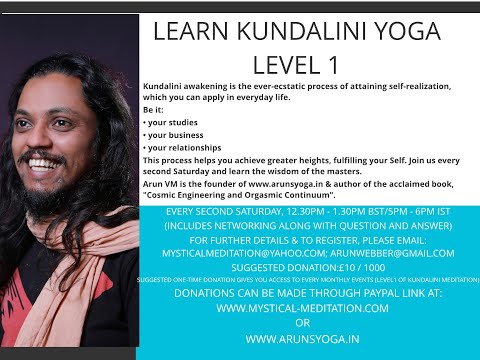
Online Kundalini Yoga Learning Session Level 1 For Beginners

Learn yoga with dolly Nigam @arunsyoga4509
"The Tao Of Tantric Yoga": A Book Review

Vedic Reading Series Episode No.15: 'The Politics of Naked Yoga For Men'

Kriya is different from Yoga

#144 Chakrasana Learn yoga with anu?


Leave a Reply